

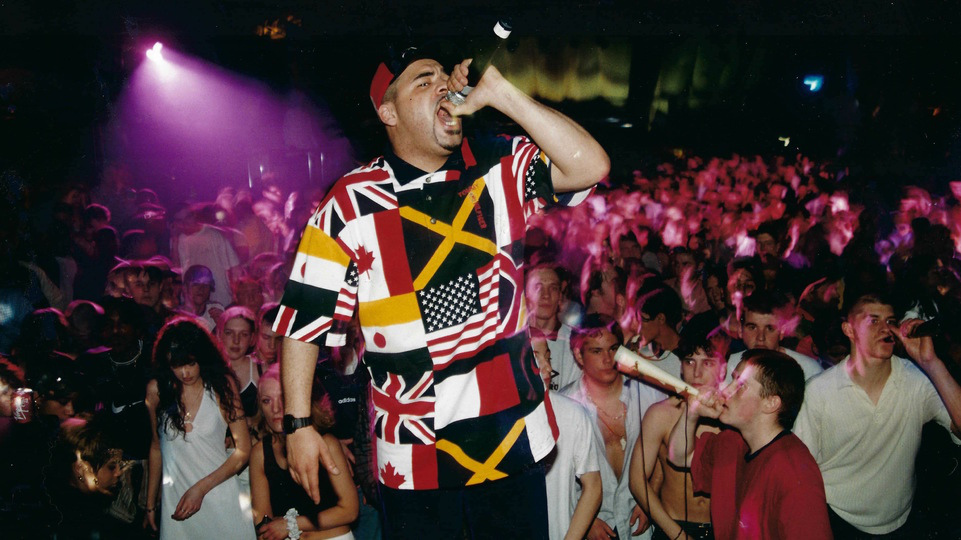

It is ten years since arguably the most influential British MC to ever grace a microphone passed away. Stevie Hyper D left a legacy that will never be forgotten by the generation that was lucky enough to see him in his prime. This is Kmag’s tribute to the man who changed drum & bass forever.
Toronto, May 1998: Stevie Hyper D has just been awarded the prestigious Lyricist of the Year award at the World Hardcore Dance Awards. On accepting his award, he announces to the watching crowd, “the future of jungle is gonna be about the vocals – it’s all about the vocals”. Less than two months later, he was dead at the age of just 31.
Having signed a deal with Island Records 18 months previously, the future had indeed looked bright for Stephen Austin. Born in September 1966, he grew up as a dedicated student of a ragga sound system in Fulham, southwest London before being enticed into the exciting new world of hardcore and jungle in the early 1990s.
With a unique tongue-twisting ability and the versatility to jump from hip hop to ‘double time’ to ragga at the drop of the hat, Hyper D helped to increase the importance of the MC beyond recognition from the early acid house days. Where they had previously relied on their ability to hype a crowd, Stevie challenged the status quo to come up with innovative lyrics that not only fitted the music but carried a real message.
“Through the microphone I’m a slave – I’m never gonna stop ’til I’m in a grave,
I ramp, me no ramp, me no skin, me no play, when me chant ‘pon microphone and me say with the DJ,
Make you jump up and down now movin’ around and swing and sway, lyrics out me mouth like a hose with the spray,
Me say lyrics to make your bollock move! Lyrics to make you say hey hey! Get ‘pon the dance floor move your body with no delay.”
Unsurprisingly, his name soon became the hottest in town, with every promoter eager to feature him on their flyers. Legendary sets at Thunder & Joy with Nicky Blackmarket became a part of drum & bass folklore as fans flocked from all over the country to catch a glimpse of Hyper D.
“I used to see him down at Thunder & Joy but it was at One Nation that he made a really good impression on me,” remembers Jason Air, who went on to work with Stevie on his Diff’rent Levels project. “At the raves, some MCs can struggle to be heard but he never had that problem.”
But while the adulation of the drum & bass fraternity was one thing, the chance to take the music to the next level was what represented the ultimate challenge. “Ultimately, Steve wanted to go out there and represent the scene as an artist,” Jason explains, “it was tiring for him travelling all around the country and not getting paid that much. When he saw what the Americans were doing with hip hop, he saw the potential of what could be achieved in drum & bass.”
Having been introduced via mutual friend DJ Rizzla in 1996, Stevie and Jason began working together in the studio with the aim of creating an outlet for Hyper D’s unique sound.
“He had worked with a few people like Apollo 440 and Kenny Ken but it had never really worked out,” says Jason. “They used his voice in a sample or turned the pitch down low but I wanted to feature an MC as the artist on a track. At first it was just for one single but it turned into a whole album. I was only about 18 at the time and he had such an amazing star presence about him. He was so charismatic – the sort of person you respect straight away. When we started working it was once every couple of weeks but gradually it became every day.”
In 1997, the duo were approached by Island Records with regard to producing an album. As the label responsible for bringing stars such as Bob Marley to a worldwide audience, the signing was a crucial moment in the history of drum & bass and it seemed that Stevie was all set to become a massive star. Then tragedy struck.
“We’d just recorded everything ready for the album and that’s when he passed away,” remembers Jason. “He’d literally finished the mission that he had always talked about so the timing was crazy. We had so much material for the album so we started making two completely different ones – the first was more street and the second was more sophisticated and trying to push the boundaries. That was the one that we pushed with Island and it was pretty successful – I don’t know exactly how many it sold but it was in the tens of thousands.”
But while ‘The Next Step’ by Stevie Hyper D featuring Dfrnt Levels was well received, it almost didn’t see the light of day.
“Island were quite prepared to forget about the album completely because their investment had just been burnt out of the water,” admits Jason. “They didn’t know how they were going to promote it but Darkus, the guy who signed us up, persuaded them to do it. It would have been terrible to have not actually produced anything from all that hard work. It was all about breaking boundaries and that’s what we did. I still get people coming up to me telling me how much they liked it – maybe the real headz didn’t like it because it was quite intelligent but I was very happy with how it turned out.”
Stevie’s death on July 13, 1998, caused shockwaves in the world of drum & bass, with many fans refusing to believe the reports were true. The loss of MC Ruff a few weeks earlier had robbed the British underground of one its brightest talents but Hyper D’s demise sent the whole scene into mourning. Three weeks on, a hastily arranged night at London’s The End nightclub paid tribute to his legacy, with everyone from Fabio to DJ Rap in attendance and the proceeds going to Stevie’s family.
“Stevie made MCs think they could be superstars – he was getting people from all over the world standing up and taking notice,” reflects Jason. “He had that kind of persona where he would just go up there and do his thing because he knew how good he was. It gave a lot of people the confidence to think that they could make it big as an MC and he brought a lot of colour to the music. He could have opened the door for the whole scene if he hadn’t passed away.
“Stevie was proper ghetto but he worked hard to try and move forward in life which was really inspiring to me,” he adds. “He strived to do well for himself and not just accept the fact that he was from a poor background. He was always ringing me up talking about new ideas and new hooks so that made me determined to make it as a producer. Whenever I’m struggling to do something thinking about what Stevie was like makes me just get on with it and I have a lot to thank him for.”
With so much unused material from their time together, Jason went on to make more two more albums – ‘The First Step’ and then ‘The Legend’. The latter was released in partnership with Dance Concept’s Benny V, who explained his decision to donate all the proceeds to Stevie’s mother Ida:
“I knew him from my time at Labrynth and when I heard Jason was looking for someone to do the new album with, it seemed like a great idea. Before I was playing in the same clubs as him, I was going out to see him and I always loved what he did. We wanted to make all the proceeds from the album go to his family because they belonged to them. Stevie’s Mum wasn’t the richest lady in the world so we were pleased to help her out. Ten years have gone by since he died but there’s the new generation who are 18 or 19 and they all know about Hyper D and how good he was. You can go up to anyone in the scene and say his name and be guaranteed that everyone will love him – that’s amazing considering you’d have to be in your late 20s now to have even seen him perform.”